Founder-led performance · Reliability · Architecture
Find what is slowing Business Central, SQL Server, PostgreSQL or Azure.
Veltheon traces one business symptom across the application, database and infrastructure — then gives your team ranked evidence and a practical improvement plan.
For technology leaders and Dynamics partners responsible for critical systems.
- Founder with approximately 20 years of enterprise experience
- Founder-led
- Read-only first
- Explicit consent before collection
- Ontario, Canada
| Layer | 18:00 | 19:00 | 20:00 | 21:00 | 22:00 | 23:00 | 00:00 | 01:00 |
|---|---|---|---|---|---|---|---|---|
| Business workflow | Business workflow, 18:00: very low measured pressure | Business workflow, 19:00: very low measured pressure | Business workflow, 20:00: low measured pressure | Business workflow, 21:00: low measured pressure | Business workflow, 22:00: low measured pressure | Business workflow, 23:00: very low measured pressure | Business workflow, 00:00: very low measured pressure | Business workflow, 01:00: very low measured pressure |
| Application / AL | Application / AL, 18:00: very low measured pressure | Application / AL, 19:00: very low measured pressure | Application / AL, 20:00: very low measured pressure | Application / AL, 21:00: low measured pressure | Application / AL, 22:00: low measured pressure | Application / AL, 23:00: very low measured pressure | Application / AL, 00:00: very low measured pressure | Application / AL, 01:00: very low measured pressure |
| Service tier (NST) | Service tier (NST), 18:00: very low measured pressure | Service tier (NST), 19:00: low measured pressure | Service tier (NST), 20:00: low measured pressure | Service tier (NST), 21:00: moderate measured pressure | Service tier (NST), 22:00: moderate measured pressure | Service tier (NST), 23:00: low measured pressure | Service tier (NST), 00:00: very low measured pressure | Service tier (NST), 01:00: very low measured pressure |
| Database engine | Database engine, 18:00: very low measured pressure | Database engine, 19:00: low measured pressure | Database engine, 20:00: moderate measured pressure | Database engine, 21:00: elevated measured pressure | Database engine, 22:00: elevated measured pressure | Database engine, 23:00: moderate measured pressure | Database engine, 00:00: low measured pressure | Database engine, 01:00: very low measured pressure |
| Platform / Azure | Platform / Azure, 18:00: very low measured pressure | Platform / Azure, 19:00: very low measured pressure | Platform / Azure, 20:00: low measured pressure | Platform / Azure, 21:00: low measured pressure | Platform / Azure, 22:00: moderate measured pressure | Platform / Azure, 23:00: low measured pressure | Platform / Azure, 00:00: very low measured pressure | Platform / Azure, 01:00: very low measured pressure |
| Storage & compute | Storage & compute, 18:00: low measured pressure | Storage & compute, 19:00: moderate measured pressure | Storage & compute, 20:00: elevated measured pressure | Storage & compute, 21:00: high measured pressure, where the measurements converge | Storage & compute, 22:00: high measured pressure, where the measurements converge | Storage & compute, 23:00: elevated measured pressure | Storage & compute, 00:00: moderate measured pressure | Storage & compute, 01:00: low measured pressure |
Reading: pressure is not in the application. It concentrates in storage latency once posting and reporting overlap — so adding compute would have bought nothing.
/ How an engagement runs
Collect. Correlate. Rank. Verify.
One business symptom, traced across the estate until the measurements agree. Every step is drawn here.
Step one · collect
Signals from every layer — and consent before a single one is taken.
Six layers, sampled read-only: the business workflow, the application and AL, the service tier, the database engine, the platform, and storage. Nothing is collected before the scope is agreed in writing, and nothing needs write access.
Hot statement · 34.6% of DB time
Synthetic estate · deterministic engine · not customer data/ Where we create leverage
A sharp entry point. A broader architecture lens.
Performance is often the first visible problem. Veltheon can stay with the system through reliability, modernization and the architecture around it.
- Sustainable
- Scalable
- Secure
- Future-ready
Business Central & database performance
Trace a slow workflow through the application, SQL Server or PostgreSQL, storage and network layers — then rank the fixes by evidence.
BC / NAV · SQL Server · PostgreSQL02 / RELIABILITYArchitecture, reliability & disaster recovery
Make the hard platform calls with failure domains, cost, observability and recovery in view — and prove the recovery on a clock rather than assuming it.
Azure · HA / DR · SRE · Scalability03 / MODERNIZATIONNAV, Business Central & data modernization
Move critical systems without treating migration as a file-copy exercise — preserve controls, reconcile the data and design the destination to operate well.
Dynamics NAV → BC · Data migration/ Where we start
Before we redesign anything, we check what you are already carrying.
Two questions cost almost nothing to ask and are skipped more often than any others. How far behind the published release ladder is this estate? And does its behaviour match a failure pattern already written down?
Neither question is answered by software we sell you — today a practitioner asks them, by hand, at the start of the engagement. The release ladder is a matter of public record. The patterns are Veltheon’s own field notes; we do not redistribute any vendor’s bug database, and we do not treat the absence of a published fix as evidence that nothing is wrong.
- Unbounded growth in a housekeeping tableExample of a matched pattern
A table that is only ever written to, never trimmed. Nothing looks broken for a long time, and then everything is slow at once.
- Bulk insert quietly disabled by a subscriberExample of a pattern checked and not matched
A single subscription can turn set-based writes into row-by-row ones across the whole system. Checked on every estate, and recorded as checked.
Illustrative. These are examples of the kind of pattern we keep, not findings from a customer system.
/ What you can expect
Evidence-driven, not model-driven.
Automation reads more of an estate than a person can. It does not get to decide what changes, or why — and it has never watched your month-end close.
- 01
Evidence before opinion
Separate measured facts from assumptions. Explain the finding, the evidence behind it and what remains unknown.
- 02
Privacy and consent
Agree the scope before collecting evidence. Start read-only and request only what the investigation needs.
- 03
Clear ownership
Make decisions, validation and operating responsibilities explicit. Leave your team with a handover it can review and use.
- 04
Honest boundaries
State what is proven and what is not. Recommendations are not permission to change production; implementation is separately scoped.
- 05
Founder-led delivery
The person who scopes the engagement is the person who runs it and answers for the result. No handoff to a junior bench after the sale.
Engagements are scoped, run and answered for by Neeraj Kumar, Founder and Principal Architect. The experience behind Veltheon →
Read our trust and security commitments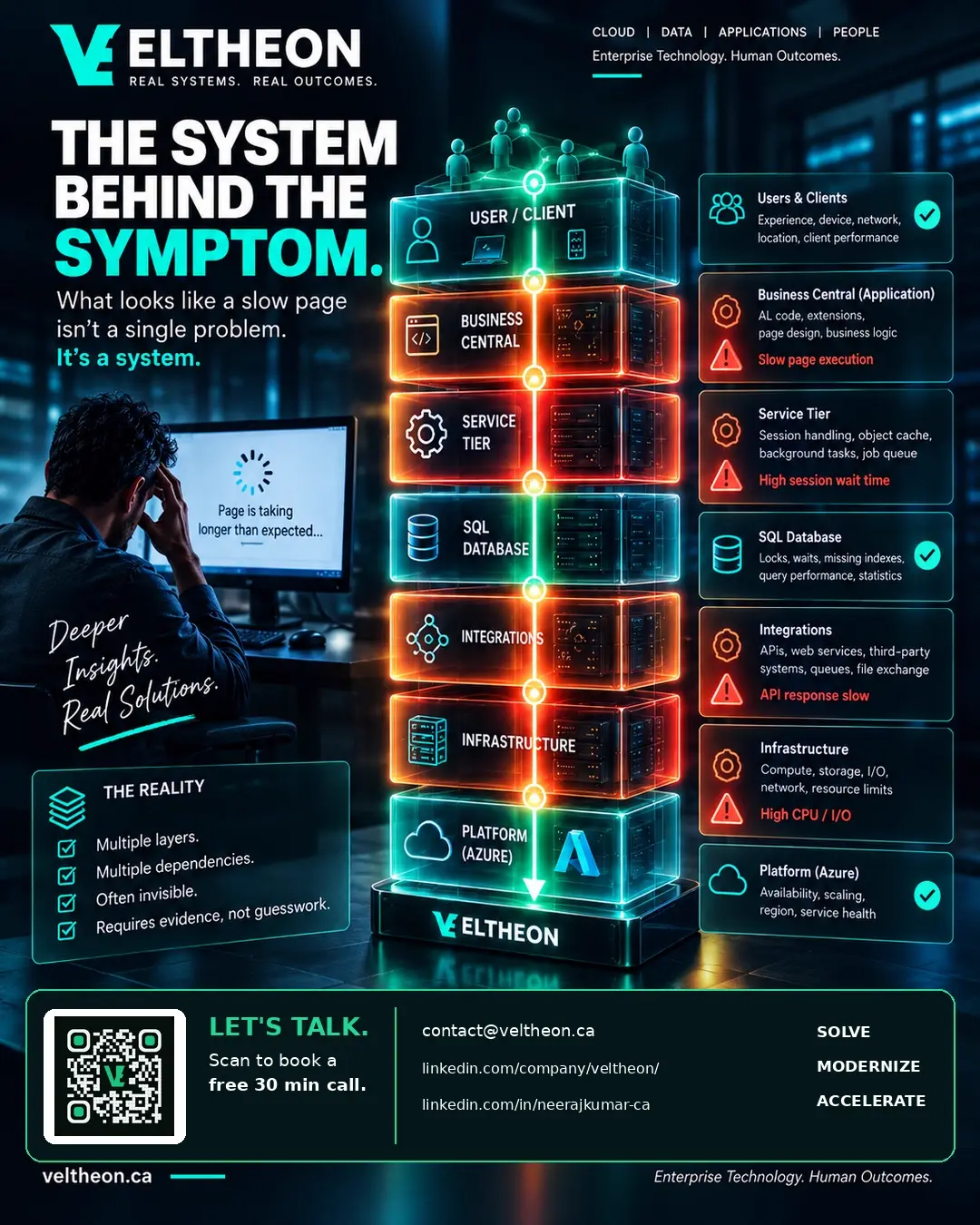 Latest
The system behind the symptom
 Edition · 10
Architecture for AI and Agents: Models Are Only One Layer
 Edition · 9
Data Platform Architecture: Storage Is Not the Product
 Edition · 8
Pipeline Architecture: Make Every Stage Observable
Get new field notes by email
Occasional, and only about what these are about. One click to leave, no account needed.
/ Start with the symptom
Bring the slow workflow, recurring incident or architecture decision.
We will identify the first evidence worth collecting and tell you plainly whether Veltheon is the right fit.